Why Strategic Leaders Should Care About Evidence-Based Policing
By Dr. Ben Havers - Strategic Research Manager, British Transport Police
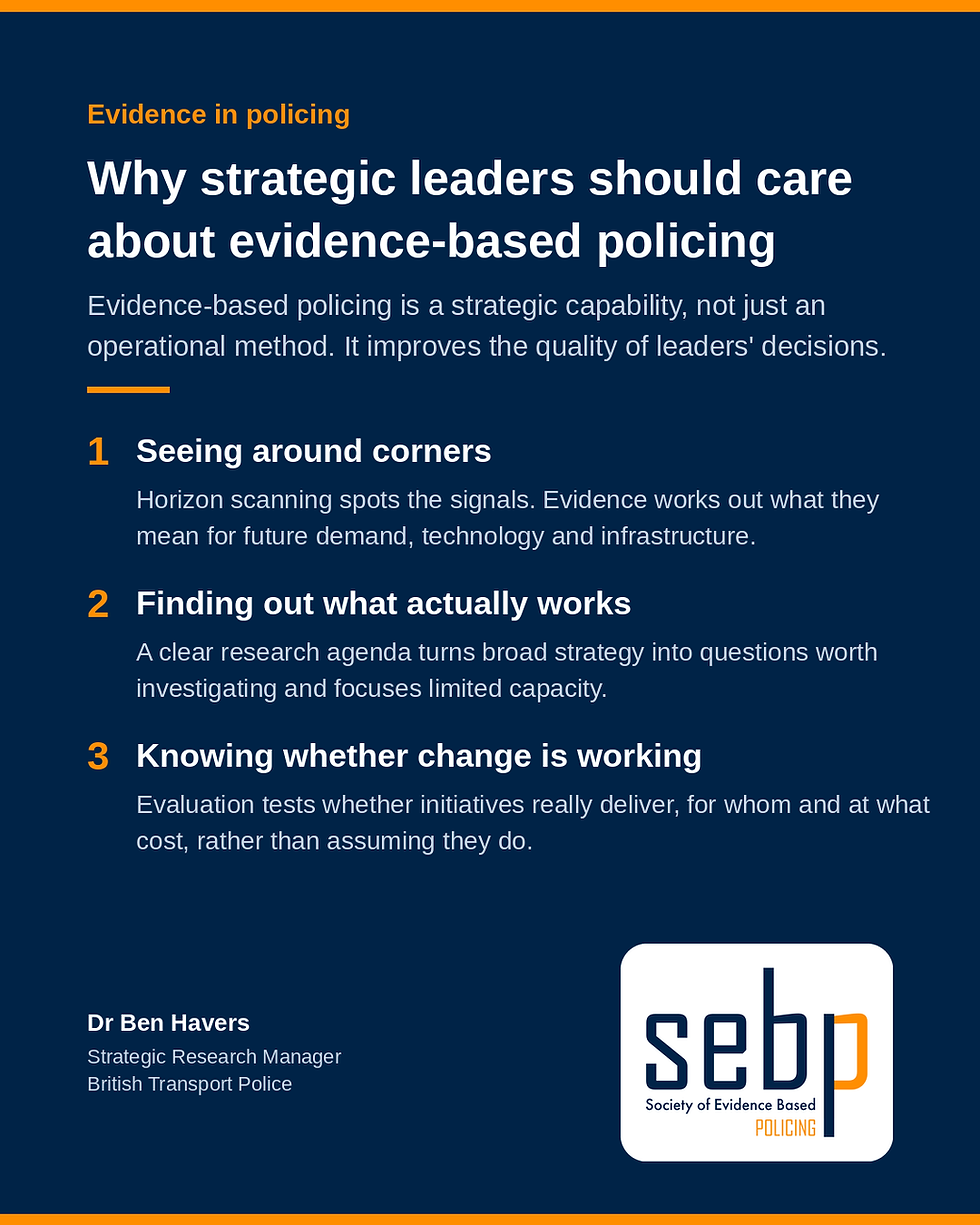
When people hear the term evidence-based policing, they often think about frontline tactics, crime reduction interventions or operational problem-solving. Those things matter, of course, but I sometimes think we undersell one of the biggest contributions evidence can make: helping forces to deliver their strategic ambitions by making more informed decisions - what to prioritise, where to invest, what to stop doing and how to prepare for what is coming next.
Most forces are good at responding to today's challenges. The harder task is preparing for the issues we have not fully encountered yet.
In a rail environment, those questions can feel especially practical: what capabilities will we need in five or ten years' time? Where will future demand come from? What impact will new technologies have on crime, investigations and public expectations? How might a new station, arena, rail route or major event change local demand? Which emerging risks deserve attention now, before they become operational problems? These are exactly the kinds of questions that evidence-based policing can help answer.
1) Seeing Around Corners
One of the most valuable things a force can do is lift its head above the day-to-day pressures and look at what's changing in the wider environment. That is particularly important on the railway, where changes to infrastructure, passenger behaviour, technology and the wider transport system can all affect future demand. That's where horizon scanning comes in.
At BTP, we've spent a lot of time considering signals that could affect future policing demand on the railway. Some of these are obvious, such as major rail infrastructure projects, station redevelopments and large-scale events. Others are less obvious, including demographic change, emerging technologies, evolving criminal methodologies and new forms of vulnerability.
The reality is that identifying a signal is only the beginning. Knowing that a major infrastructure project such as HS2 is being delivered tells us very little on its own. The useful questions come afterwards. How might it affect passenger volumes, crime patterns, crowding, trespass risk or demand at particular locations? What new partnerships might be needed with rail operators, local authorities, event organisers or other police forces? What skills, training or specialist capability might officers and staff need?
This is where research and analysis become important. Evidence-based policing provides a structured way of moving beyond speculation and developing a clearer understanding of what a trend or development might actually mean in practice. We can draw on existing research, analyse internal data, examine comparable examples from other places and commission new studies where significant evidence gaps exist.
The same applies to emerging technologies such as artificial intelligence. Most of us can see that AI is likely to have implications for policing, but evidence is needed to understand what those implications actually are. Research can help us assess where AI might support decision-making, where it could introduce risk, what safeguards are needed and whether a tool is improving practice or simply adding another layer of complexity.
In short, horizon scanning helps us spot potential challenges and opportunities. Evidence helps us work out what they mean, how seriously to take them and what we might need to do next.
2) Finding Out What Actually Works
Evidence-based policing is not just about answering interesting questions. It is about answering the questions that matter most to the organisation. Every force has far more potential research topics than it has time or resources to pursue. Without some way of prioritising activity, research can become fragmented and disconnected from organisational need. That was one of the drivers behind the development of BTP's Areas of Research Interest (ARIs). The objective was not simply to create a list of topics for academics. It was to identify areas where stronger evidence could support better decision-making, guide external research proposals and help focus limited organisational capacity on the questions most likely to add value. The agenda is directly linked to our force Strategy, with 3 ARIs per Strategic Objective.
For example, if the force wants to improve outcomes around vulnerability, violence against women and girls, victim care, offender management or emerging technology-enabled threats, evidence gives us a practical route in. Research can help define the problem, identify who is most affected, understand what is already working, test assumptions and explore which approaches are most likely to improve outcomes.
A research agenda also helps with practical decisions. It can shape which academic partnerships we pursue, which proposals we support, which topics we invite people to work on and where we need to build a stronger evidence base ourselves. In that sense, evidence-based policing acts as a bridge between strategy and delivery. It turns broad priorities into questions that can actually be investigated.
3) Knowing Whether Change Is Actually Working
Perhaps the strongest strategic argument for evidence-based policing is its role in helping organisations understand whether change is actually delivering the benefits that were intended.
Policing is constantly investing in new technologies, programmes, processes and ways of working. There is often understandable enthusiasm about the potential of these initiatives, but good intentions and promising ideas do not automatically translate into positive outcomes. Without evaluation, it can be surprisingly difficult to know whether an intervention is genuinely effective, whether it represents value for money, or whether there are unintended consequences that need to be addressed.
Research and evaluation provide the mechanism for answering those questions. They help organisations move beyond anecdote and assess what is actually happening in practice. That might mean looking at whether a pilot is improving outcomes for victims, whether a new process is reducing demand, whether training is changing behaviour, or whether a digital tool is helping officers make better decisions. Just as importantly, evaluation gives leaders evidence on which to base decisions about whether an initiative should be expanded, adapted or discontinued.
A useful example is BTP's work with the College of Policing to evaluate an artificial intelligence tool designed to support stop and search supervision. The final results are awaiting publication, but the project is a good example of the value of testing promising technology properly before making decisions about wider adoption. It has helped ensure that any future decisions are informed by evidence about the tool's benefits, limitations and practical use in a policing context. For me, that is exactly what good evaluation should do. It creates a structured way to test promising ideas, understand how they work in practice and consider any benefits, limitations or risks before decisions are made about wider use.
In areas such as AI, where the pace of change is fast and the consequences of getting it wrong can be significant, that kind of careful, evidence-informed approach is especially important.
This example captures an important aspect of evidence-based policing that is sometimes overlooked. The purpose of research is not to prove that something works. It is to find out whether it works, for whom, in what circumstances and with what risks or trade-offs. Those are very different things. Evidence that a project has not yet demonstrated sufficient benefit can be just as valuable as evidence that it has. Both outcomes reduce uncertainty, improve future decision-making and contribute to organisational learning. In an environment where resources are limited and demands continue to grow, that learning has real value.
So What Does This Mean For Strategic Leaders?
Research cannot predict the future with complete accuracy and evaluation will never answer every question. Strategic decisions will always involve judgement. What evidence-based policing can do, however, is improve the quality of that judgement. In practical terms, it can help a force decide whether a promising pilot is ready to scale, whether a new technology is worth adopting, whether a partnership is delivering value, whether a rail or infrastructure development requires investment now, or whether a long-standing way of working needs to change.
For me, that is why evidence-based policing should be viewed as much more than an operational methodology. It is a strategic capability. It helps organisations anticipate change, focus attention, test assumptions and learn from experience. At a time when policing faces growing complexity, increasing demand and difficult choices about where to invest resources, that feels less like an academic luxury and more like a core part of good strategic decision-making.
Declaration of interest: I work for British Transport Police as Strategic Research Manager and lead work relating to the force's research agenda and research governance.
Generative AI was used to support the drafting and editing of this article. The ideas, opinions and conclusions remain my own.