Trauma-informed policing: the evidence, the misuse, and the missed opportunity
Easier Said Than Done, Episode 11
Trauma-informed practice has become one of the most talked-about ideas in modern policing and, according to this month's Easier Said Than Done panel, one of the most misunderstood.
Matt was joined by two of the field's leading practitioners for an hour that moved from neuroscience to national policy, and from officer wellbeing to public spending:
Dr Jane Pepa, former head teacher, now trauma lead for the Merseyside Violence Reduction Partnership, having trained over 12,000 people (including more than 4,000 police officers) in trauma-informed practice.
Justin Srivastava retired police superintendent, former trauma-informed lead for the Lancashire Violence Reduction Network, the NPCC's public health portfolio, and the Global Law Enforcement and Public Health Association-
There's no single definition and that's the problem
Both panellists opened by admitting the field lacks a shared definition. Jane is currently writing her second research paper specifically on this gap, warning that without a substantial, evidence-based definition, "trauma-informed" risks becoming "wishy-washy" - a label anyone can claim after a half-day session. Justin pointed to the SAMHSA model (used by the Department of Health and Social Care) built around principles like psychological safety, trust, empowerment and cultural awareness but noted that even the word "trauma" carries different meanings across health, education and policing audiences, and that getting the narrative right matters as much as the content.
The evidence: this is as much about officers as the public
A recurring theme was that trauma-informed practice isn't primarily a public-facing intervention - it starts with the workforce. Dr Pepa's "battery pack" analogy that officers can't run on empty, and can't extend compassion to others from a depleted reserve - anchored a wider point: understanding trauma changes how officers see their own experiences, not just those of victims and suspects.
The numbers back this up:
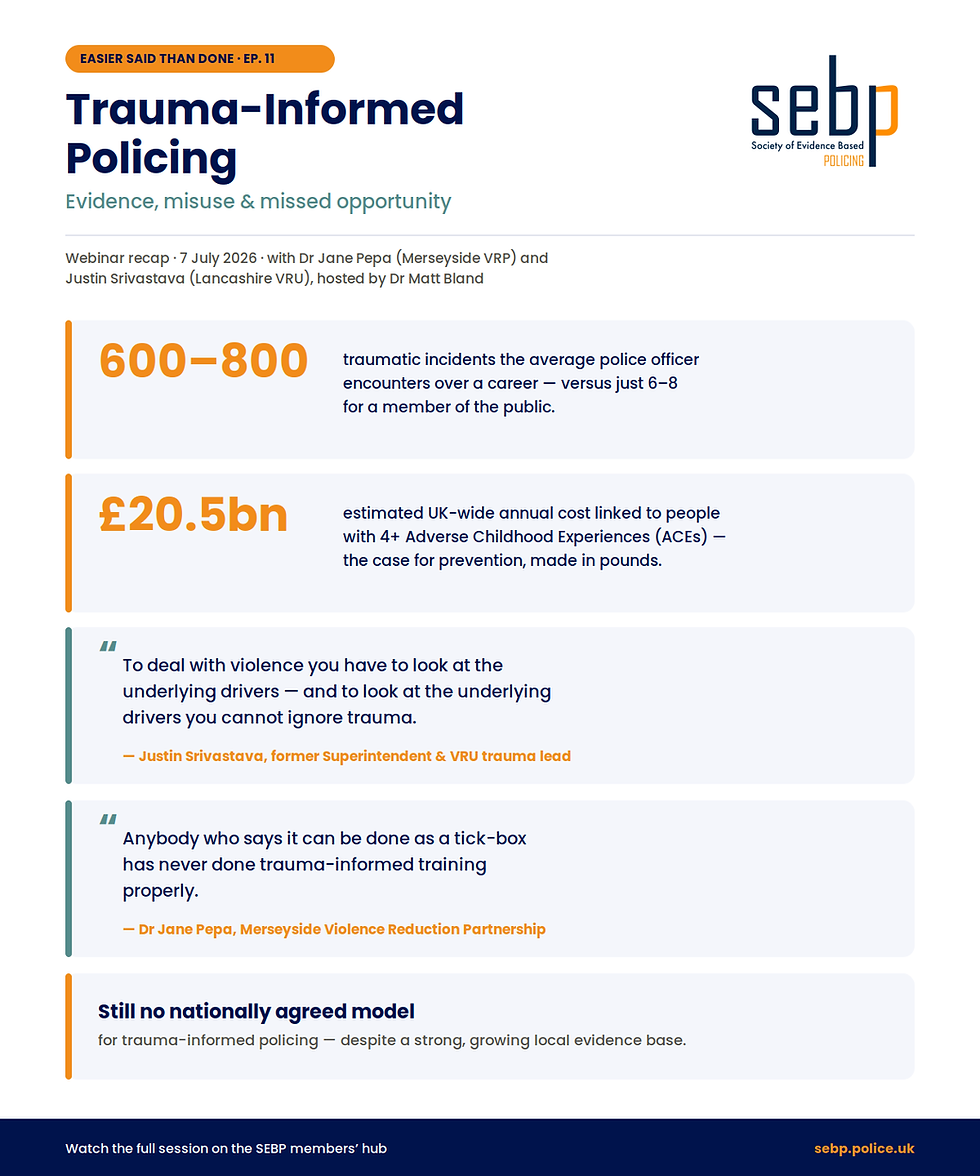
The average member of the public experiences 6-8 traumatic incidents in a lifetime; the average police officer encounters 600-800.
Around 70% of the population has experienced at least one trauma. People with four or more Adverse Childhood Experiences (ACEs) cost an estimated £6,000 per person per year - roughly £20.5 billion UK-wide and are significantly more likely to experience impaired mobility, chronic pain, anxiety and depression.
Those with six or more ACEs die, on average, 20 years earlier than the general population.
The wider European cost of ACEs has been estimated at £748 billion.
As Srivastava put it: prevention and early intervention through trauma-informed practice speaks to "the whole fundamental reason why we joined policing in the first place."
The misuse: when trauma-informed becomes a tick-box
Both speakers were candid about how the language gets diluted. Short e-learning modules, one-off two-hour sessions, and "trauma awareness" repackaged as "trauma-informed practice" were named as recurring problems, sometimes leaving staff frightened rather than equipped, or organisations wrongly believing a single course means they've "arrived."
Jane's view was blunt: genuine practice requires depth (Merseyside's model runs to nearly eight hours, blended with e-learning and ongoing organisational support), plus a "wraparound" safety net of occupational health, supervision, and follow-up so people aren't left to process difficult material alone.
The missed opportunity: no national model, but plenty of resources
Despite strong local evidence bases, Merseyside, Lancashire, and VRUs across England, Wales and Scotland, there is currently no single, nationally agreed model or curriculum for trauma-informed policing, and training remains inconsistent between forces. This makes the evidence base harder to pin down centrally, even though practitioners see the impact daily.
The panel pointed listeners toward existing resources that don't get enough visibility: the College of Policing's public health approaches hub and landscape reviews, the Youth Endowment Fund toolkit, individual VRU websites (which routinely publish their own evaluations), and a newly released UK & Australia scoping review on trauma-informed policing.
The takeaway
Trauma-informed practice, done properly, is a whole-system, multi-agency commitment - not a training course to complete once. It has to work top-down (mandated by system leaders) and bottom-up (embedded in day-to-day culture), and it has to look after the people delivering it as much as the people receiving it. Or, as Srivastava summed up the case for taking it seriously: "to deal with violence you have to look at the underlying drivers, and to look at the underlying drivers you cannot ignore trauma."
Watch the full session on the SEBP members' hub. Membership is free!