From Tragedy to Transformation: How Evidence‑Based Policing and Partnership Reduced Harm on the Lincolnshire Coast
Written by Barnaby Prince
Police Community Support Officer at Lincolnshire Police
Dementia Safeguarding Lead & Member of the force Safeguarding Network
Police lead for the Atlantis Alliance – Collaborative Coastal Working
Every summer, the Lincolnshire coastline attracts millions of visitors. Families arrive for rest, recreation, and connection but behind the scenes, policing, rescue and community services prepare for intense demand, heightened risk, and devastating consequences if things go wrong.
This blog tells the story of Operation ATLANTIS, a multi‑agency, evidence‑led response to missing children on Lincolnshire beaches. It is not a story of a single intervention or a “silver bullet”. Instead, it is a practical example of how evidence‑based policing, structured problem solving, and true partnership working can reduce harm, save lives, and deliver real value for policing and the public.
The Catalyst: Why Change Was Necessary
In August 2022, a child was reported missing on the Lincolnshire coast. A large‑scale multi‑agency search was launched. After five hours, the child was tragically located in the water and pronounced dead at the scene.
No agency failed. Every service responded professionally and with commitment. Yet the incident exposed a difficult truth: the system was almost entirely reactive. That moment became the catalyst for change.
SCAN: Understanding the True Scale of Harm
Following the 2022 season, neighbourhood teams at Mablethorpe and Skegness conducted a detailed review with partner agencies.
What the data revealed
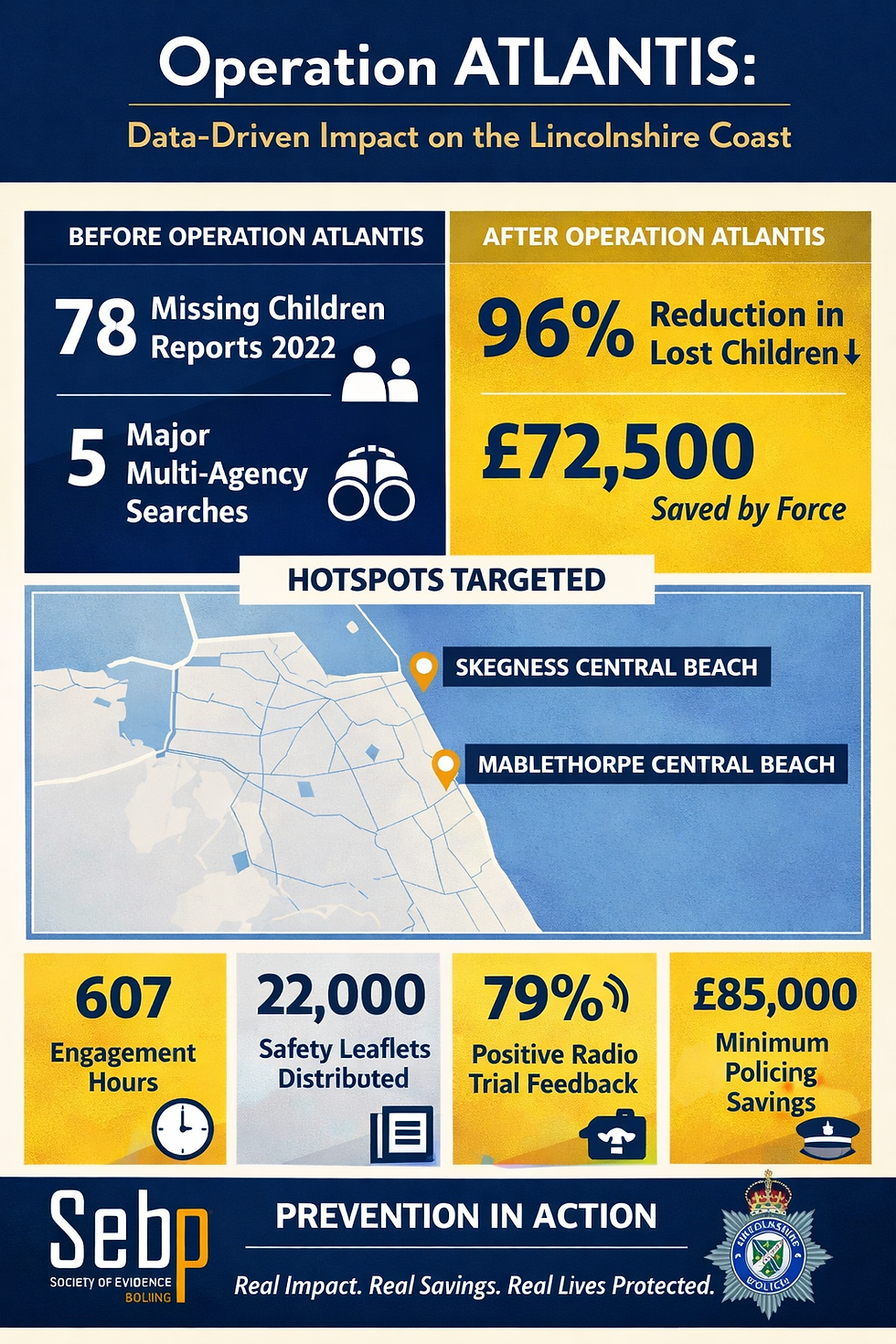
Police systems recorded 22 lost or missing children from beaches.
RNLI lifeguard data recorded 56 reports, including 39 multi‑agency searches.
On the day of the fatal incident, officers recalled around 10 missing children, yet only four were formally logged.
The conclusion was clear but uncomfortable: despite best efforts, policing did not fully understand the scale or nature of the problem.
Patterns emerged even within incomplete data:
Two consistent hotspots: Skegness Central Beach and Mablethorpe Central Beach
Peak risk hours between 1300–1900, with highest risk 1600–1900
All children were under 13, non‑local, and visiting the county
National RNLI data confirmed this was not unique, Skegness consistently ranked among the busiest beaches nationally for multi‑agency missing‑child searches.
ANALYSE: Why Was This Happening?
Partner analysis and frontline debriefs identified multiple contributory factors:
Lost‑child searches are extremely resource‑intensive, often pulling officers from core policing duties
Officers were deployed close to water without appropriate rescue equipment
Preventative engagement was minimal and largely shouldered by policing alone
Agencies routinely worked in parallel rather than together
Communication relied on separate radio systems, creating risk during live incidents
The working hypothesis was that children became lost due to:
Crowd density and spatial disorientation
Lack of local knowledge
“Holiday psychology” - a perception that beaches feel inherently safe
Across all findings, one gap stood out: prevention.
RESPOND: Operation ATLANTIS
Using the SARA problem‑solving model, partners redesigned their approach from the ground up.
Building the Alliance
Agencies brought together included:
Lincolnshire Police
RNLI Lifeguards and Lifeboats
HM Coastguard
National Coastwatch
Local councils
Holiday parks and community businesses
Joint training, tabletop exercises, and honest debriefs clarified roles, formalised shared objectives, and embedded daily points of contact.
A Visible, Preventative Model
The Sandi Starfish wristband scheme became central:
Free wristbands for children and vulnerable adults
Highly visible safe‑point flags staffed by trained partners
Distribution by police, lifeguards, Coastwatch, businesses and holiday parks
Children knew where to go. Adults knew what to do. Prevention became everyone’s responsibility.
Smarter Responses
On operational days:
Teams staffed hotspots between 1100–1900
Every incident logged via police CAD and a shared missing‑child log
Single points of contact coordinated searches
Early dynamic risk assessments prevented escalation
In 2024, partners trialled shared Airwave and VHF communications, significantly improving live incident coordination. An anonymous staff survey later showed 79.16% of respondents agreed or strongly agreed that the radio trial had a positive impact on their work.
ASSESS: What Changed?
Across 2023–2025, the results were clear:
96% reduction in reports of lost and missing children
Minimum policing savings of £85,000
This saving was calculated using national average investigation costs:
Low/medium risk incidents: £2,500
High‑risk incidents: £8,500
Based on reduced demand, this equated to:
£72,500 saved between 2022/23
£12,500 saved between 2023/24
Additional outcomes included:
607 recorded staff engagement hours across 44 days in hotspot areas
22,000 pieces of crime‑prevention and water‑safety literature distributed
Frontline and partner feedback echoed these findings:
“In my 15 years with the RNLI, this is the closest I’ve seen our organisations work together and it’s translated directly into better outcomes.”
An independent review by Lincoln University corroborated the findings and the evaluation report can be provided on request.
Learning Forward
Success did not end the learning cycle. New risks emerged including paddleboards drifting, weaver fish injuries, and UXO washing ashore, all now addressed through partnership planning.
Future priorities include:
Reaching families before they travel
Better data capture on public engagement
Joint, synchronised media messaging
Expanding interactive engagement methods
Continuing regular multi‑agency debriefs year‑round
Why This Matters
Operation ATLANTIS demonstrates that:
a tested approach (POP) can be practically applied
Prevention saves lives, money, and wellbeing
Collaboration requires structure, trust and accountability
The SARA model is not abstract - it is deeply practical
Most importantly, it shows that complex safeguarding problems cannot be solved by policing alone.
If there is one question this project leaves for all of us, it is this:
“What are we only reacting to that we could prevent together?”