Announcing the Full Programme for the 2026 National Evidence-Based Policing Conference
What Works in Delivering Police Reform | 23–24 September 2026 | The Open University, Milton Keynes
We are thrilled to announce the full speaker programme for this year's National Evidence-Based Policing Conference - the flagship event for everyone who believes that good evidence should sit at the heart of policing.
Hosted at The Open University in Milton Keynes on 23–24 September 2026, the conference brings together leading researchers, senior police leaders, policymakers and practitioners for two days of debate, insight and genuine knowledge exchange. Tickets are just £99 for both days, including lunch and refreshments.
Day One: 23 September
The conference opens with remarks from Al Murray OBE, Executive Chair of the Society of Evidence Based Policing, and Professor David Phoenix, Vice Chancellor of The Open University, before moving straight into a headline keynote panel -The Big Picture - featuring some of the most senior voices in UK policing:
Chief Constable Jason Hogg, Thames Valley Police
Rt Hon Sarah Jones, Minister for Policing
Chief Constable Gavin Stephens, National Police Chiefs' Council
Chief Constable Sir Andy Marsh, College of Policing

Morning Sessions
Professor Nick Fyfe (University of Dundee) and Professor Andy Wooff (Scottish Institute for Policing Research) will examine the lessons, opportunities and challenges of police reform in Scotland - a valuable case study for forces across the UK.
After a networking break, the morning continues with two sessions that cut to the heart of the reform challenge. Professor Rob Briner (Queen Mary University London) asks a provocative but important question: You can't change workplace behaviour by changing 'culture' - so what does work? He is followed by Professor Tom Kirchmaier of the London School of Economics, presenting the evidence on what actually works in reforming large organisations.
Afternoon Sessions

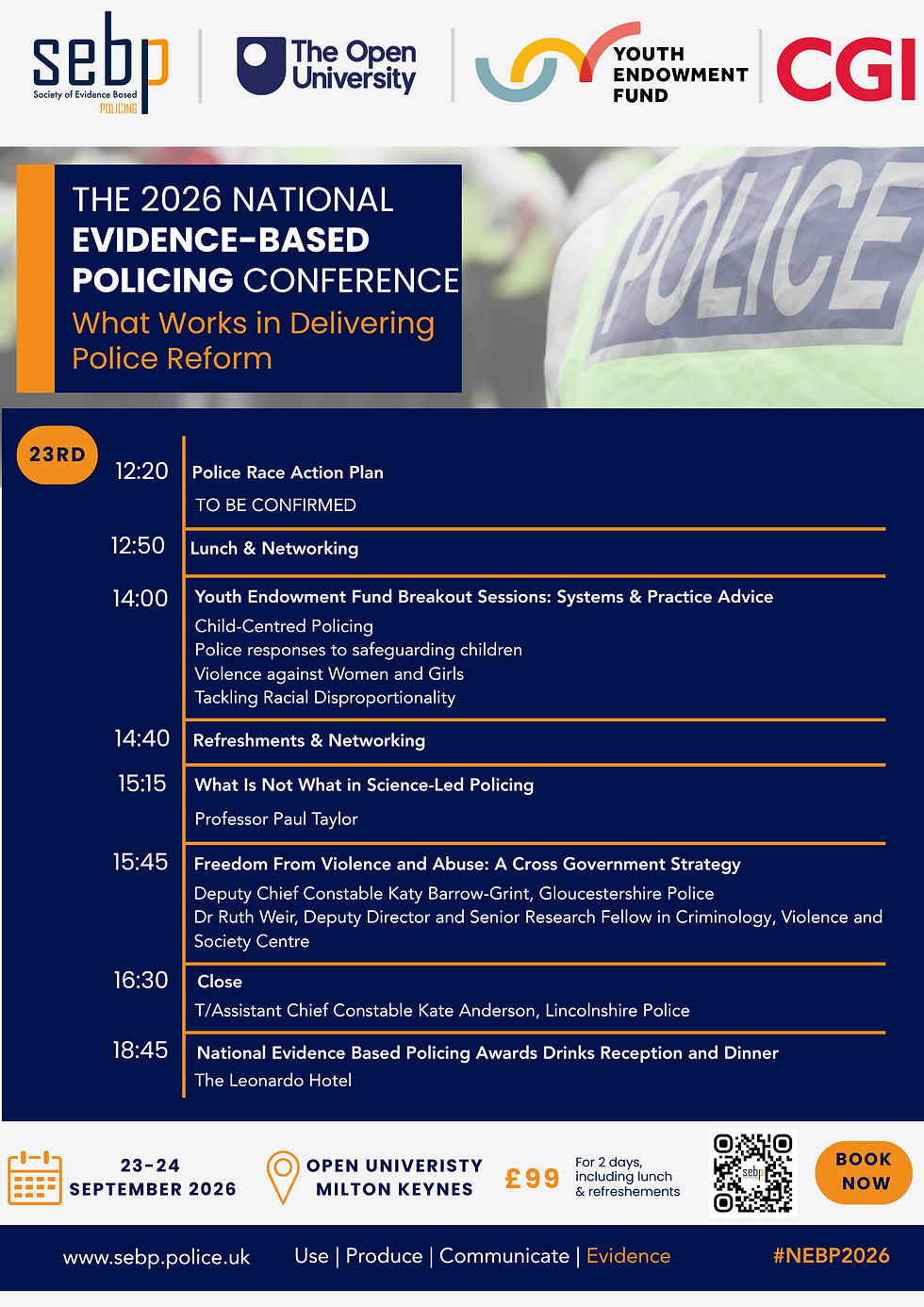
The afternoon includes a session on the Police Race Action Plan, followed by a rich set of Youth Endowment Fund Breakout Sessions covering child-centred policing, police safeguarding responses, violence against women and girls, and tackling racial disproportionality.
Professor Paul Taylor then takes the stage to address a topic that cuts through the noise: What Is Not What in Science-Led Policing - a timely reminder to apply the same critical rigour to policing research that we ask of policing itself.
The day closes with a session on Freedom from Violence and Abuse: A Cross Government Strategy, presented by Deputy Chief Constable Katy Barrow-Grint (Gloucestershire Police) and Dr Ruth Weir (Violence and Society Centre), before the formal close from T/Assistant Chief Constable Kate Anderson (Lincolnshire Police).
Evening: National EBP Awards Dinner
Day one ends in style with the National Evidence Based Policing Awards Drinks Reception and Dinner at The Leonardo Hotel - a wonderful opportunity to celebrate the best of evidence-based practice across the country.
Day Two: 24 September
Day two opens with an important panel on Evidence-Based AI in policing, bringing together practitioners from across the landscape: T/Chief Superintendent Lewis Lincoln-Gordon (Police AI), Chief Superintendent William Lyne (Head of Economic and Cybercrime, Metropolitan Police), Greg Elliot (National Crime Agency), and Chief Inspector Tom Perry (West Yorkshire Police).

Breakout Sessions
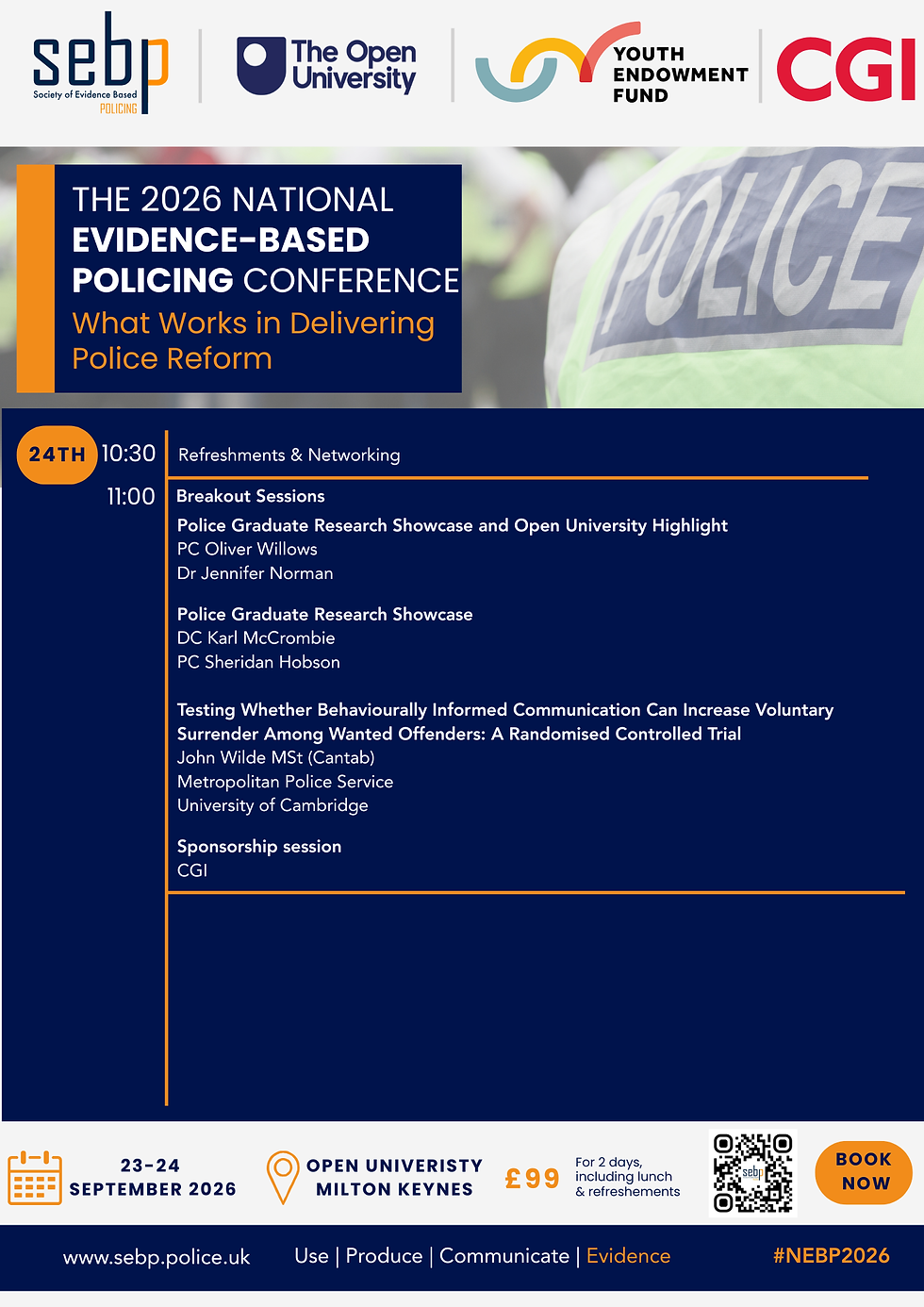
A packed programme of breakout sessions follows across both the morning and early afternoon, showcasing some of the most compelling applied research in the field:
From Enforcement to Care: Embedding Indirect Victim Support in Online Child Sexual Abuse Investigations - Mille Fjelldal-Robertson
Understanding Police Time Use, Demand and Complexity through the Police Activity Survey - Jake Walker and Lucy Green
Does Focussed Deterrence Work Outside Cities? Lessons from Rural Implementation - Jennifer Laibach and Chris Williams, Wiltshire OPCC
The 'Where, Who, How, and Against Whom' of Street Sexual Harassment in the Night-Time Economy - Dr Ioana Crivatu and Detective Inspector Tina Wallace
Police Graduate Research Showcase -PC Oliver Willows, DC Karl McCrombie, PC Sheridan Hobson
Testing Whether Behaviourally Informed Communication Can Increase Voluntary Surrender Among Wanted Offenders: A Randomised Controlled Trial - John Wilde MSt (Cantab), Metropolitan Police Service / University of Cambridge
Forecasting Future Demand for Strategic Analysis - Dr Matt Ashby, University College London
From Confidence to Competence: Rethinking Police Training Effectiveness in RASSO Investigations - Dr Arun Sondhi and Professor Emma Williams, Anglia Ruskin University
Starting to Understand Demand and Capacity in Policing - Chief Inspector Colin Clarkson and Dr Joshua Skoczylis, Lincolnshire Police
Cambridge University Panel

One of the highlights of day two is a dedicated Cambridge University Panel, chaired by Assistant Professor Brandon Langley, featuring:
Detective Inspector Chris Gadd (Metropolitan Police) on Behavioural Insights in Bail Compliance: RCT Using Text Messages
Ethan Thomas (National Crime Agency) on Root Access: A Descriptive Analysis of Entry-Level Cyber Dependent Offending Using Police Data
The conference concludes at 13:10 with closing remarks from Al Murray OBE, Executive Chair of the Society of Evidence Based Policing.
Book Your Place
This is two days you won't want to miss. Whether you're a researcher, a practitioner, a senior leader or a policymaker, the 2026 National EBP Conference is the place to engage with the evidence that is shaping the future of policing.
Tickets: £99 for both days (including lunch and refreshments) Book now at www.sebp.police.uk
Follow the conversation on social media using #NEBP2026
Use | Produce | Communicate | Evidence
