#NEBP26

#NEBP2026: What works in delivering police reform, was our biggest and best national conference yet
On 23 and 24 September, The Open University in Milton Keynes welcomed delegates from across policing, academia, government and the wider public sector for the National Evidence-Based Policing Conference 2026. With every place taken well ahead of the event, NEBP2026 was the Society's first sell-out national conference, and the energy in the building matched the demand.
Feedback from the days themselves, and from those who joined us, points to one conclusion: this was our best conference yet. The programme was broader, the speaker line-up stronger and the conversations richer than at any previous edition. Delegates told us they left with practical ideas, new contacts and renewed enthusiasm for putting evidence at the heart of policing.
A programme worth the wait
The 2026 programme brought together a remarkable range of voices. Here is a flavour of what delegates heard:
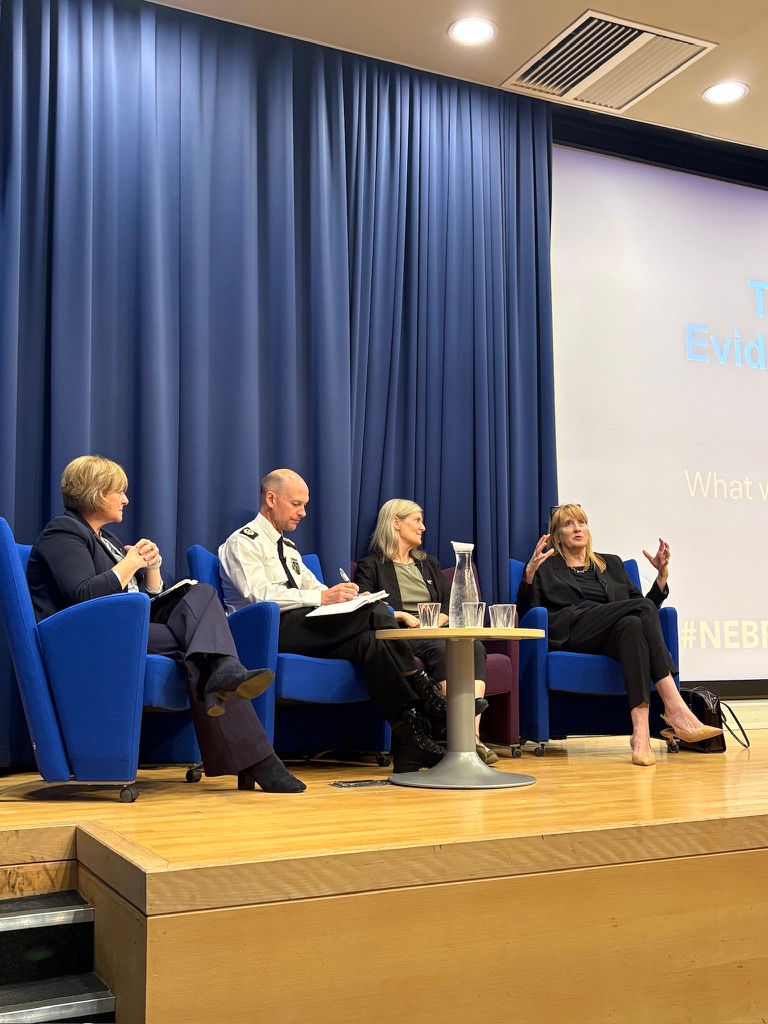
Day one opened with a keynote panel bringing together Sarah Jones MP, Minister of State for Policing and Crime; Chief Constable Jason Hogg, Thames Valley Police; Louisa Rolfe OBE, Policing Reform Lead, National Police Chiefs’ Council; and Rachel Tuffin OBE, Director of Performance, Productivity and What Works, College of Policing. The panel looked at how evidence-based practice can sit at the heart of the new National Police Service, and what the evidence says about doing reform well. A few themes kept coming up: build evidence in from day one; use national data and shared problem-solving to do things individual forces can't; protect neighbourhood policing; and keep the focus on better service for communities and the workforce. Lessons from the Netherlands and Police Scotland were especially useful, from setting a baseline early to not letting local policing slip while national capability grows. Audience questions covered how to measure success, the perverse incentives created by short-term targets, and why officers trust street experience over training. The point that landed most was about closing the feedback loop. People are asked for their views but rarely hear what changed as a result, and the Minister named it as her main takeaway from the session.
Professor Andrew Wooff, Director of the Scottish Institute for Policing Research, drew six reflections from more than a decade of police reform in Scotland, making the case that consolidation is not the same as transformation and that the existence of a new organisation is not evidence that reform has worked. His closing message was that reform is a long process rather than an event, and that building academic partnerships early is what turns it into a learning opportunity.
Professor Rob Briner, Professor of Organizational Psychology at Queen Mary University of London and Associate Director of the Corporate Research Forum, asked why culture change has become the go-to answer to almost every behaviour problem, from the Post Office scandal to poor behaviour in policing, when there is no agreed definition of culture, no consensus on how to measure it and no studies on whether culture change interventions actually work. His argument was that culture describes behaviour rather than causing it, and that the alternative is to identify the specific, observable behaviours that drive an organisation's objectives and change those instead.
Professor Tom Kirchmaier, Director of the Policing and Crime Research Group at the LSE's Centre for Economic Performance, opened with a blunt economic reality: with productivity growth across the wider economy as weak as it is, there will not be more money available for policing any time soon. His answer was organisational rather than financial, arguing that the precondition for benefiting from AI is building an organisation that can be automated in the first place, and that the gains come from relentlessly optimising processes one by one, led by your own staff rather than by consultants.
These sessions were complemented by a wide range of breakouts led by an impressive line-up of speakers, and a busy exhibition in the Library Atrium.

The Awards Drinks Reception and Dinner at the Leonardo Hotel then gave us the chance to celebrate this year's nominees and winners, including Peter Neyroud CBE QPM PhD, recipient of the Lawrence W. Sherman Prize for his career contribution to evidence-based policing.
Our four category winners were:
Emerging Talent Award: Christina Harding, Detective Constable at Essex Police, for From Prediction to Prevention, a project exploring how machine learning could support domestic abuse risk assessment.
Police–Research Partnership Award: Katy Barrow-Grint (Gloucestershire Constabulary) and Dr Ruth Weir (City St George's, University of London), joint winners, for their work getting teenage relationship abuse into the government's VAWG strategy.
Policing Innovation Award: Inspector Jack Stabler of Cumbria Constabulary, for the Cumbria Road Harm Index, which prioritises road safety where the harm is greatest.
Excellence in Evidence-Based Prevention of Violence Involving Children Award (with the Youth Endowment Fund): Operation Inclusion, Merseyside Police's Youth Intervention Unit, for its deferred prosecution route for first-time entrants to the youth justice system.
If you missed any of our conference sessions, or weren't fortunate enough to join us this year, we will be making all sessions available to watch on our members hub soon. Keep an eye out here https://www.sebp.police.uk/
Thank you
A conference of this scale depends on the generosity of many people. Our sincere thanks go first to our principal partner, CGI, whose support made NEBP2026 possible, and to our partners the Youth Endowment Fund and The Open University. We are also grateful to our speakers, sponsors, exhibitors, award nominees, volunteers and colleagues at The Open University, and above all to every delegate who joined us and contributed to the discussion. You are what makes this community what it is.
Looking ahead to 2027
Planning for the next national conference is already under way. We are aiming to hold it in September or October 2027, and we will share the date and venue as soon as they are confirmed.
Given how quickly this year's event sold out, we would encourage anyone interested in attending to act early.
Membership: your route to a ticket
Tickets for our national conference are available to Society members. If you're not yet a member, joining now is the best way to be first in line when booking opens, with discounted rates for next year's conference and advance notice of our online and in-person events. Membership also gives you access to the Members' Hub, packed with 'Get Started' guides, free training courses, event recordings and practical tools, plus a monthly newsletter rounding up the latest research and case studies. It's open to anyone committed to evidence-based approaches, whether you are a serving officer, researcher, policymaker or engaged community member. You can join at www.sebp.police.uk. We look forward to seeing you in 2027.
